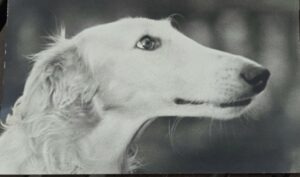
The Borzoi, or as it was called in ancient times, the catcher, is the oldest dog used to serve man. Since time immemorial, man has used borzoi-type (sighthound type dog) dogs to hunt wild animals. Ancient Egyptian images of these dogs have survived to this day. The origin of borzoi-type dogs is North Africa, then the deserts and steppes of Asia Minor and Central Asia, which are most suitable for their use in terms of landscape, and further on – the regions of the North Caucasus, the Caspian and Black Sea steppes. However, there is also information about northern, Celtic, borzoi-like dogs. The Greek author Arian (first half of the 2nd century AD) wrote that even then these dogs were an existing breed.
Borzoi dogs probably came to the Moscow state from the south, where they had been used for hunting for a long time. There are many sighthounds’ breeds, more than twenty. The process of their formation in different countries is different and is related to natural and climatic conditions, but all hound-like dogs have one thing in common – speed.
We will list here only those breeds that participated in the formation of the ancient native gusto- and chistopsovaya Borzoi: the Mountain, Crimean, English, Hortaya (Polish harts) and Central Asian (tazy). It is possible that the Kurland Borzoi also participated to a further extent.
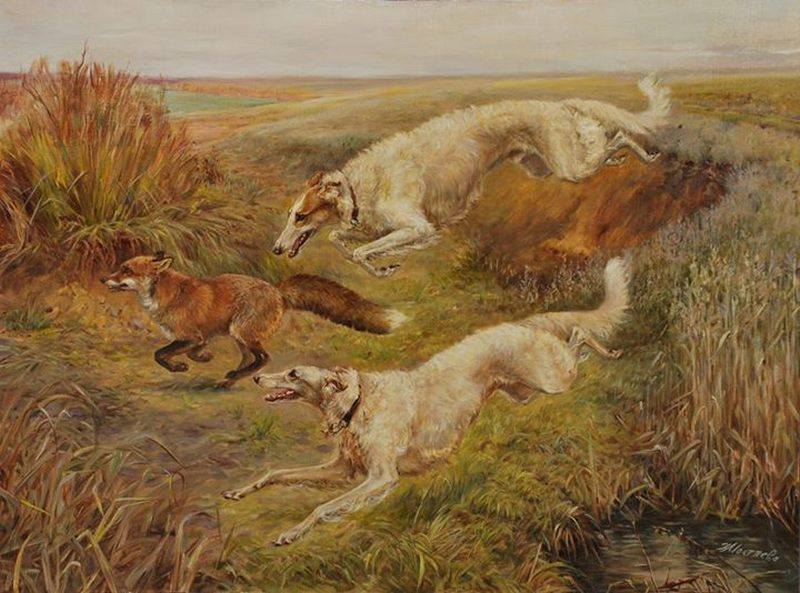
Foxhunt
The Borzaya was the foundation and pride of Russian dog breeding, and in Leningrad, only Psovaya Borzaya were and are bred. We will discuss them here. When hunting with borzoi, guns are not needed at all, as the dogs catch up with and catch the animal by themselves.catch hares and foxes, catch up with and hold the grey predator in a death grip until the hunter arrives and ties up the wolf. They hunt with them in fields, in steppe and forest-steppe areas, with the horses, on foot, in winter – from sleds, in which they carry dogs to hunting places, and let them go when the animal comes up, which the dogs chase.
The Russian Borzoi is our national pride. The beauty and agility of the Russian Borzoi have made it world-famous and widely spread in various countries around the world. Only these dogs are bred in Leningrad.
Perhaps no other breed of hunting dog survived the revolution in such small numbers and in such a disparate state as the famous Russian breed, renowned throughout the world for its beauty: the Russian Psovaya Borzaya.
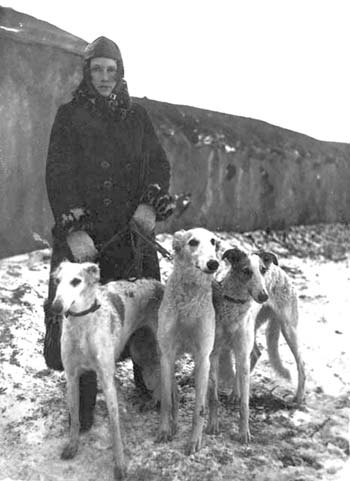
Hunting with borzoi, which mostly used to belong to big landowners and famous people, disappeared after 1917. The most famous of these hunts were the Pershinskaya hunt, which had 365 dogs, and the Gatchinskaya hunt. Some of the borzois were taken abroad by their former owners, while many dogs were ‘destroyed’ or simply lost. The breed did not remain pure among the dogs that settled in the hunting places in villages and villages. The Gatchina hunt was sold by the Temporary Government to foreigners for currency, and only the revolutionary events of October made it impossible to take the remaining dogs abroad. Several descendants of these dogs remained in Leningrad. Thus, only a few dogs of the Russian borzoi breed survived, ending up, one way or another, in the hands of true enthusiasts, to whom we still owe the preservation and later the rebirth of the breed. These enthusiasts were mainly dog breeders from Leningrad and Moscow. Unfortunately, it was not possible to reproduce the exact origin of many dogs.The 1923 dog show, held by the Leningrad hunting organisation, played a key role in the development of dog breeding in Leningrad in general and in bringing together the previously dispersed Leningrad borzoi enthusiasts. Of particular importance was the union of dog breeders in 1926 in the breed sections of the Leningrad Hunting Union, and then in the Leningrad Hunters’ Association. From that time on, Leningrad borzoi, united in the borzoi lovers’ section, began their collective work on “restoring” the breed. The organizers of this work were A.A. Mezentsev, K.H. Matveev, and the author of these lines. All purebred borzoi in Leningrad and its suburbs were identified and registered. Slowly, a group of active members formed, including N.N. Gresser, O.V. Vurm, O.M. Kuznetsova, V.M. Ivanova, V.V. Gaidukov, A.K. Dometi, and others.
Eugenia Desor
Let us look at how exhibitions and the association of borzoi lovers influenced the development of the breed. At the 4th exhibition of the Lengubpromkhozsoyuz in 1925, there were 12 borzoi, and two years later, at the 8th exhibition in 1927, there were already 39 (exhibitions were held twice a year at that time). At the 12th exhibition in 1929, 48 dogs were brought into the ring. The expert at the exhibition was N.N. Chelishchev, who appreciated the Leningrad dog population very highly.In his report on the next XIII exhibition, the famous borzoi expert M.I. Alekseev writes: ‘In terms of borzoi, Leningrad is undoubtedly in first place in the whole of the USSR, both in quantity and quality, the borzoi owned by Leningrad enthusiasts at that time, seven played a key role in the development of the breed and can rightly be considered its founders.There are three littermates – Ch. Chaus of Z.M. Maller, Chvan of A.A. Mezentseva and Chara of K.H. Matveeva (descended from dogs of the old Gatchina hunt), as well as Ch. Chaika and her two sons, Ch. Sipai and Ch. Blistai, who belonged to the author of this essay. According to the well-known cynologist G.P. Kartsev, Ch. Chaika also came from the aforementioned Hunt, which he managed in 1917, but it has not been possible to establish its origin with any documentation. And finally, Trolli of S.M. Bystrova (then N.N. Gesser) of unknown origin and mediocre appearance (only a Small Silver Medal), but in combination with Ch. Sipai, she produced a number of excellent and very good dogs – Laska Matveeva, Geteru Vedenyapina, Ch. Silva of Desor and others, the first two of which also left a significant mark on the breed. Then Lady Gaidukova (Dandy of Kalyanskogo – Chara of Matveeva) and Cherkiza II of Matveeva of unknown origin entered in the breed thanks to her son Vityaz Kokushkina from his mating with Venera of I.O. Sidorova.Special mention should be paid to Lady of Gaidukova. From three males – Sipaya of Desor, Lelia of Ivanova and Armavir-Divensky of Desor – she produced a number of gold medalists, some of whom are listed among the ancestors of many borzoi in the country: Ch. Migai of A.N. Koroleva (from Ch. Sipaya) and littermates Ch. Golub of Matveeva, Gaidar I and Golubka of Desor (from Armavir-Divensky). An excellent borzoi male was Ch. Troyan of Matveeva (from the daughter of Ch. Chaus Potekha of Vurm and Laskaya), who, unfortunately, left no sign in the breed.However, since from the very beginning the main producers were the littermates Sipai and Blistai, and on the other hand, three littermates, Chaus, Chvan and Chara, it soon became necessary to enlarge the possibilities of breeding.
Armawir-Divenski
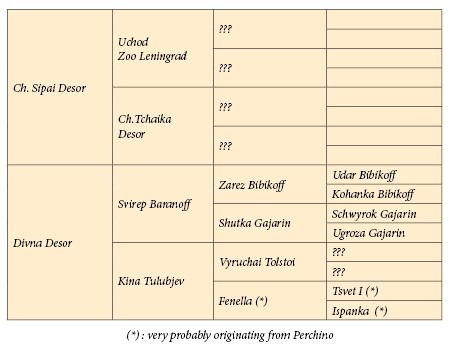
For this purpose, in 1927-1928, two dogs were purchased: A.A. Mezentsev in Moscow acquired a bitch named Dara of unknown origin, and the author of these lines acquired a bitch named Divna in the Tula Region, a descendant of the Pershinsky bloodline from Kina, owned by the famous hunter N.I. Tulubiev, and Svirpa, owned by A.A. Baranov. Divna’s pedigree also included dogs belonging to the famous hunters Tolstoy, Gagarin, and Mamontov. Mated with Ch. Sipay, Divna produced Armavir Divensky, who can be found in the pedigrees of most modern greyhounds, and from a mating in Moscow with Ch. Strepet N.V. Gvozdeva, she produced Struna Divenskaya, who had a significant influence on the Moscow borzoi group.
Tiranka II
Dara also proved to be a successful acquisition: she produced interesting offspring from her mating with Ch. Chaus, but unfortunately, her imprint on the breed was limited only through Ch. Kapriz Divenskiy (Lada-Armavir Divensky), an excellent bitch with a lively temperament, who was subsequently widely used as a brood bitch at the Saratov State Kennel of the Regional Consumer Union. At the same time, the mating of Chvan of Mezentsev with Geterya of Vedenyapina produced another champion, Tiranka II Dometi.
Kapriza Divenskaya
Pedigree Armawir
At the 1935 All-Russian Exhibition, Tiranka II and Kapriza Divenskaya took first places.The years 1927-1934 were marked not only by an increase in the quantity and quality of Leningrad borzoi, but also by a number of group field trips with dogs; the organisation of artificial hare races at the State Hippodrome under the leadership of N.A. Sumarokova and A.A. Mezentsev, who awarded diplomas to four dogs: Jeyran of V.V. Ivanov, Tiranka II of A.K. Dometti, Pobedka I.of D. Kuznetsov and Silva of E.F. Desor.
Although the terrain of the Leningrad Region is not suitable for hunting with borzoi, the dogs still had the necessary training at that time and did not lose their working qualities. They raced after an artificial hare at the hippodrome with no less enthusiasm and agility than they would have shown after a living one.
In 1935-1937, many borzoi owners left Leningrad, and the breed in the city declined sharply. But even in those years and in the years that followed, the enthusiasts who remained in Leningrad continued their beloved work. These included V.V. Ivanov, who died during the blockade, I.D. Kuznetsov, A.N. Trakhtenberg, N.A. Martyanova, A.N. Aleksandrova and many others.
After the war and until 1959, there were either no borzoi at all at Leningrad shows, or only a few specimens appeared. Among the latest were Altai and Atlanta Divenskaya, purchased by A.N. Trakhtenberg and E.V. Kotlyarova, who survived the blockade, and several others, temporarily brought to Leningrad.
However, Leningrad borzoi continued to influence the further spread of the breed, only now not in Leningrad, but in Saratov and the Saratov Region, where the author of these lines took five of his borzoi (including Armavir, Gaidar I and Golubka), and then, on the basis of these dogs, and later by acquiring dogs from Leningrad from Matveev, Dometti of I. Sidorov and others, two state kennels were organised: the Saratov and Balandinsky borzoi kennels of Soyuzpushniny and Oblpotrebsoyuz.
Both of these kennels played a significant role in breeding and supplying purebred puppies to hunters in Saratov and other regions, as well as to other kennels that were being established in the country at that time.
The Leningrad borzoi that ended up in the Saratov region and their descendants excelled at hunting, field trials, and many showed good temper and excellent skills in the trials. Three wolves were hunted down by borzoi from the Balandinsky (later Engels) kennel near the village of Balanda.
Vyuga
The breed was maintained almost exclusively by dogs of Leningrad bloodlines, as at that time there was only one local female dog in Saratov, of N.F. Sidorova, and the rest of the region had only selected dogs. This bitch, in combination with Gaidar I, entered the breed and is found in the ancestors of modern Moscow, Kuibyshev and other groups of borzoi.
In 1957, the Engels kennel introduced into the breed a male borzoi named Amur, purchased in Penza from A.M. Parshin, which carried some of the blood of local dogs and Orel I, imported from the German Democratic Republic by F. Nevezhin.
Raketa
Raketa with progeny
The restoration of the breed in Leningrad actually began in 1959, when four bitches, Shalost, Metel, Groza and Volga, and several puppies were brought from the liquidated Engels kennel. The author of these lines brought Raketa, who was born in the same litter as Metel and Groza. The first three bitches and two puppies were purchased by the Leningrad Society of Hunters for the purpose of restoring the breed, while the rest were distributed among Leningrad enthusiasts of the breed.
Of the adult dogs, two bitches, Shalost and Raketa, in addition to having an ‘excellent’ evaluation, had third-degree diplomas for wolf hunting .
These five dogs became the basis for the restoration of the borzoi breed in Leningrad. All the dogs were closely related by origin, and breeding work required maximum ingenuity.
Grozny
It was decided to strengthen the influence of the best male dog in the country from the Engels kennel – the champion of the breed and the Exhibition of Achievements of the National Economy , Grozny, a dog of excellent exterior and good temperament (second and third degree diplomas for wolf hunting).
Grozny was descended from Krylatka Divenskaya (Leningrad bloodline) and from Gordy, the son of Femina, imported from the GDR by the Moscow Society of Hunters, and Kida of E.P. Komarova, who also had 40% Leningrad blood.
Picture from a show in Leningrad
And so, in 1960, after a long break, Russian borzoi again graced the rings of the Leningrad exhibitions.At the All-Russian exhibition, Leningrad borzoi took first and third places in the conformation ring and first and second places in the show ring. Having returned Leningrad’s native dogs to the Leningrad Society of Hunters and Fishermen (LSOiR), breed enthusiasts once again joined forces in the borzoi section and took on both breeding and training the dogs.An ‘artificial hare’ machine was constructed, and the dogs, like their Leningrad ancestors before them, eagerly chase the ‘ hare’. However, the section does not yet have a place to hold this event in public, so training takes place outside the city.
In terms of exterior, our borzoi do not shame their ancestors. Of the 21 dogs that have been evaluated, 10 received ‘excellent’, 10 received ‘very good’ and only 1 received ‘good’.The rest of the population consists of young dogs born in 1965-1966 that have not yet been shown at exhibitions and breed shows. The degree of class is not important. There were two qualified dogs, now there is one. Leningrad borzoi need to organise field trials with game.During this time, Leningrad once again became the centre for breeding and spreading the Borzoi. Between 1961 and 1966, 45 puppies were sold, mostly to other regions and republics, as well as abroad. Three dogs were sent to the GDR, two to Czechoslovakia, and one to Finland. The Estonian Republic purchased six puppies from us, and the same number were purchased by hunters in the Tula, Astrakhan and other regions, where they are used for their intended purpose and are very popular.
Argol
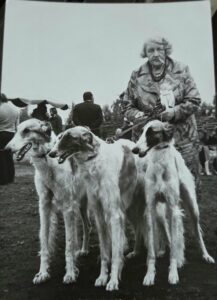
Dezor with the best borzoi of the show. Leningrad, 1977 . Borzoi : Boyar, Zaryana, Zavlada, owner NI. Kozlov
The main stud dog was of S.G. Leibur, grandson of Ch. Grozny, and over the last three years – Gudal of V.A. Kozhemyakina, Podar of N.A. Anuryeva (already having a qualified descendant) and Shurgay of V.P. Kulakov. Of the adult population brought in 1959, the Leningrad Society of Hunters’ Metel was used most intensively.
All of our borzoi have ancestors from many of the breeders mentioned at the beginning of this essay, but the major influence was made by Armavir Divensky, whose inbreeding in various combinations was widely used by both the author of this review on his own dogs and on the dogs of the Saratov kennel, giving good results.
Zlata, Leningrad, 1977
Over the years, a friendly group of breed enthusiasts has formed in the Leningrad Borzoi section: V.A. Kozhemyakina, E.A. Rybchinskaya, E.I. Shpakovskaya, A.A. Ivanov, N.A. Martyanova, L.V. and V.P. Kulakovs and others, and from the old guard – V.M. Maximov, E.V. Matveeva and the author of this essay, who heads the section’s office.
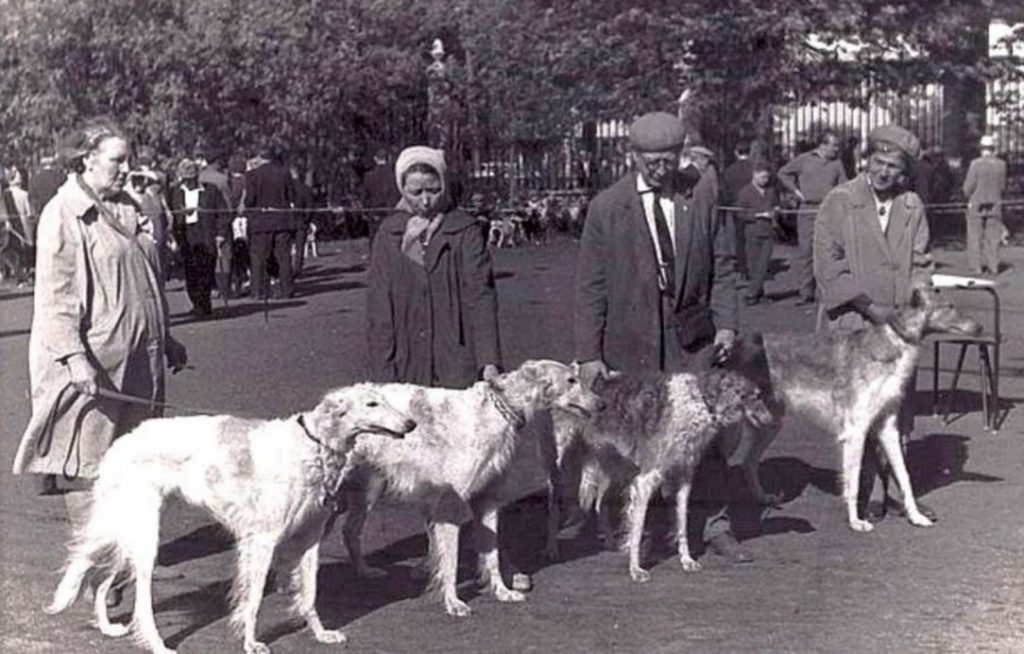
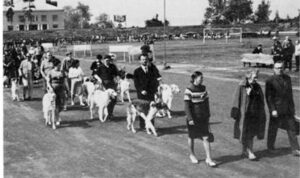
Parade of Borzois Leningrad 1972
Throughout the period covered by the essay, the author took an active part in the preservation and development of this remarkable breed of dogs.