
Hunting trial on wolf By A Korsh, February 1879 issue of Nature and Hunting/submitted by J.L.Johnson


On January 4th of this year, 1879, during the Imperial Hunting Society’s exhibition, a wolf pit was held on Khodynka Field, at the Moscow Racing Society’s compound, for His Imperial Majesty, Grand Duke Nikolai Nikolaevich the Younger, who honored the exhibition with his presence. All previous wolf pits, including the one held at the Exercising House in 1875, had been public, but this particular pit was purely for hunting purposes; not only was there no announcement of it anywhere, but, to avoid publicity, the hound hunters were only given notice the day before.
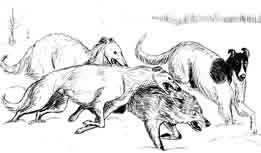
Fig. E. Halmoshi

Because of this, there were almost no public, meaning by this word non-hunters, at the cages, but there were a lot of hunters, despite the early hour.
The weather on the day of the hunt was not particularly favorable; the frost, accompanied by a biting wind, reached 15-16 degrees Celsius, and the field was smashed so hard that the dogs cut their feet. Furthermore, the deep snow, in which the dogs sank up to their ears while holding the wolves, posed a significant inconvenience. However, despite all these obstacles, the hunt was not only satisfactory, but even successful, since, with the exception of one pack, which hesitated a bit, all the others took the wolves well. Comparing this hunt with previous ones, especially the first, one inevitably comes to the conclusion that the number of vicious dogs has increased and that the hound hunters have become more diligent in hunting wolves. Five packs participated in this hunt: E. I. V. V. Prince Nikolai Nikolaevich Jr., V. A. Sheremetyev, N. A. Boldarev, S. S. Kareyev, and N. V. Mozharov.

The Grand Duke’s pack was the first to be released, consisting of two piebald males, F.V. Protasyev’s breed: Opromiet and Odinor.
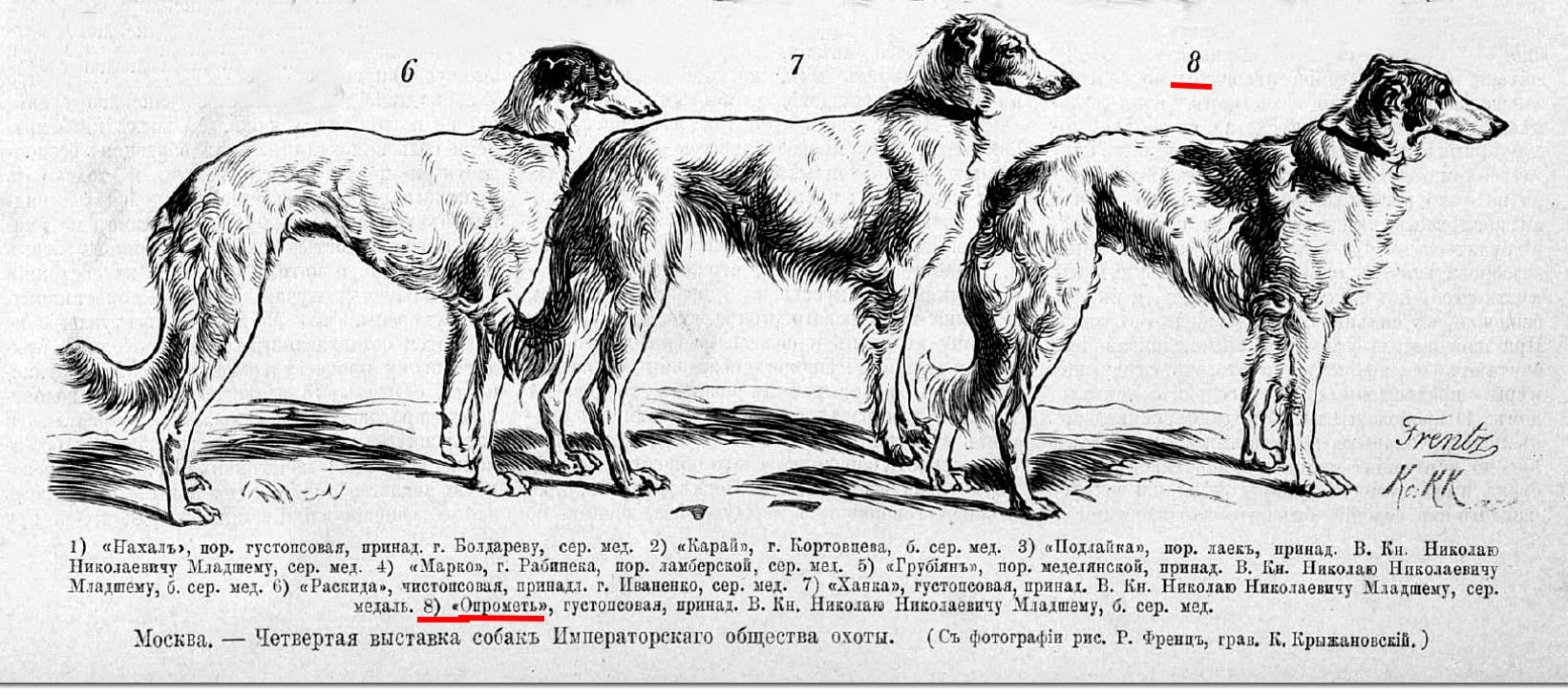
Opromiet No 8 (submitted by Andrus Kozlov)

Opromiet got the wolf but broke free, then Odinor arrived, pulled the animal down, broke free for a second, and grabbed it by the ear without releasing it; Opromiet followed him from the other side. Although the wolf was not immediately brought down, nevertheless, even the most demanding hunter cannot admit that this pack is kind and that an uncaught wolf will not escape from it in the field. A third male of the Grand Duke, the grey-piebald Udar, said to be a dog of proven ferocity, was brought to the leash, but, by His Highness’s will, he remained on the leash, as the ferocity of only two piebald males, recently acquired, was intended to be tested. The second pack released was that of N.A. Boldarev’s pack, consisting of three dogs: two of F.V. Protasyev’s breed—the fawn-eared male Nakhal and the gray-spotted Porazhai—and the white male Nakhal, his own dogs, the son of Zhikharev’s Nagrazhdai, who distinguished himself with his ferocity at the first mount. A brief overview of the area is necessary to describe this mount: to the left, a little back from the boxes from which the wolves escaped, was a kind of low embankment or knoll with two or three bushes. The wolf, planted for Mr. Boldarev’s pack, ran from the box to the left, a little back over the knoll, because when Mr. Boldarev’s greyhound handler released the dogs from the pack, they rushed toward the spot where they had just seen the wolf, that is, toward the box, and then, at the greyhound handler’s whooping, they darted left. By this time, the wolf had managed to climb the knoll and sit in the bushes. Porazhai was the first to reach him, lunging at the wolf, but it snapped away, and Porazhai leaped far away. Then both Nahals arrived and began nipping at the wolf’s back and gacha. The wolf snapped back, but didn’t run. Then the hunters at the trap forced the wolf out of its impregnable position, and the dogs were forced to chase it, but the dogs only nipped at it and jumped back every time the wolf lunged at them. Porazhai especially stood out, jumping unusually high whenever the wolf addressed him. Finally, one of the dogs, apparently a white Nahal, finally got the wolf—and the greyhound handler took advantage of this moment, pounced on the wolf, and with the help of the other hunters, brought it down.
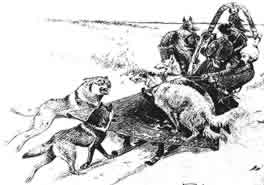
Sheremetyev’s pack was the third to be released, consisting of two piebald males from his dogs: Zlodey and Razboynik. Zlodey was the first to reach the wolf and grabbed it by the scruff of the neck, and Razboynik immediately followed him from the other side. Both dogs grabbed it without breaking away. It all happened in a single moment: the wolf never rose from under the dogs’ grasp and lay there, as if stunned. It must be admitted that such swagger and a distinct reception of a wolf had never been seen before at the Moscow cages. I can compare the ferocity of these dogs and their valiant reception only to the ferocity of A.V. Nazimov’s dogs, whose wolves, in most cases, did not dare to run.

Fig. A. Komarov, 1902

Fourth came S.S. Kareev’s pack of three piebald males, his own dogs: Terzay, Nayan, and Trezaychik. This pack prevented the wolf from escaping and captured it so unanimously that it was absolutely impossible to discern, especially given the similarity of the pack’s colors, which dog got the wolf first and which one captured it. All that can be said with certainty is that all the dogs captured it in place and without breaking away. The only thing that can be faulted, though not the dogs, but their owner, is that the wolf was placed too close.

The last to be released was N.V. Mazharov’s pack, consisting of three dogs: a black male named Mily, a male named Karay, and, I believe, a black female whose name I don’t know. The wolf was allowed to run quite far when the dogs were thrown from the pack; Mily was the first to reach the wolf and snatched him up, followed by another black dog, and they began pinching the wolf. This continued until old Karay arrived, caught up with the wolf, and grabbed him by the ear, dead, without letting go—and then the black dogs grabbed him as well. Mr. Mazharov’s pack, it seemed to me, was very uneven: the black dogs had only just finished their puppyhood and were therefore not caught, while Karay was already so autumnal that he had completely lost his agility.
After this, although the hunt was, strictly speaking, already complete, due to the failure of the wolf assigned to Mr. Boldarev’s pack, the pack was released a second time. The wolf ran well, the dogs chased him, and although they got him better than the first time, it was not particularly satisfactory, as the wolf struggled with them for a long time before they finally managed to restrain him. I was particularly surprised by the white Nakhal, descended from the white Nagrozhday, a dog renowned for his ferocity. However, Nakhal was only two years old and perhaps hadn’t seen many wolves, and with a dog like Porazhay, even a vicious dog would be embarrassed. Thus ended the hunt, during which His Imperial Majesty Prince Nikolai Nikolaevich the Younger was mounted, as was V.A. Sheremetyev, despite the severe frost and wind.
A public wolf baiting was scheduled for January 8th. The Imperial Society of Proper Hunting had paid great attention to it, developing special rules at a hound hunters’ congress, offering two prizes, and generally making every effort to satisfy both the hunters and the public. Unfortunately, however, due to frosts exceeding -15 degrees, the baiting did not take place. I say “unfortunately,” because it promised to be very interesting, given that the dogs entered were completely unknown to most hunters, such as those of Messrs. Golovin, Yankov, Gipolt, and Savin. Of particular interest was the baiting of one dog: Karai of Mr. Mazharov and Karai of Mr. Savin.
However, what’s deferred is not lost – this is a wise rule that one can take comfort in in this case.
                                                           
                                             Comment by Andrus Kozlov

This account by A. Korsh was originally published in the February 1879 issue of Nature and Hunting (A. Korsh was himself the publisher of the journal). It was one of the few journals in Russia that published articles on hunting and dogs. The journal was published for decades, and fortunately, it has now been digitized and is freely available online.
Catalog of the Russian National Library

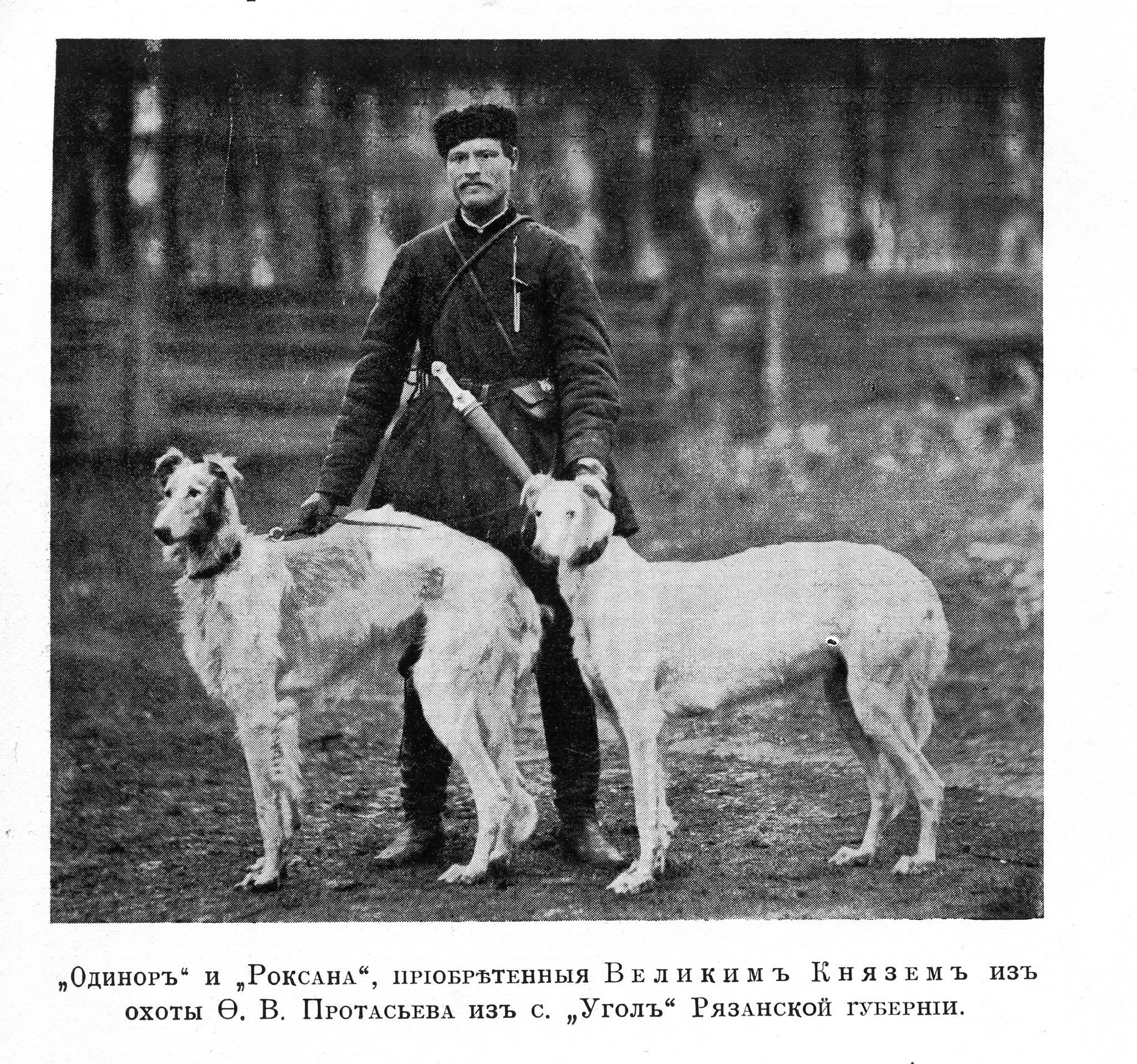
Odinor & Roksana Protasyev hunt.

Russian State Library https://search.rsl.ru/en/search… Some Vol here: https://www.digitale-sammlungen.de/en/search…
At the beginning of the account, the author discusses Grand Duke Nikolai Nikolaevich’s dogs, Opromiet and Odinor. The previous year (i.e. 1878), following the death of the landowner Protasyev, the Grand Duke purchased these two two-year-old borzois, white and fawn, from Protasyev’s heirs along with Roxana and Raskos, for a total of 1,500 rubles.
What did these dogs look like? D. Valtsov’s book The Perchino Hunt contains a photograph of Odinor. There are also drawings of Opromiet by the artists Frentz and Martynov. On the photo Odinor (on the left) and Roksana from Protasyev hunt.


Year of Event:

Country:

Personal Collections:


Source:


Author:

Dan Persson

Dogs:


Persons: